






Aptoro Managed IT Support
Most small businesses in the UK manage their IT the same way they manage their boiler, they ignore it until something breaks. Then they panic, call someone, pay too much, and wait days for a fix.
It is an expensive habit. A single day of unplanned downtime can cost a small business thousands of pounds in lost productivity, missed sales, and emergency repair fees. And that is before you factor in the growing likelihood of a cyber attack. In 2025/2026, 43% of UK businesses experienced a cyber breach or attack, according to the government’s own Cyber Security Breaches Survey. That is approximately 612,000 businesses in a single year.
Managed IT support is how businesses stop firefighting and start growing. This guide explains exactly what it includes, what UK businesses are actually paying for it in 2026, and how to choose a provider that will be a genuine long-term partner rather than just a helpdesk.
What Is Managed IT Support and How Is It Different From Break-Fix?
There are two ways to buy IT support. Most small businesses start with break-fix: you pay for help only when something goes wrong, typically at hourly rates of £75–£150. It feels economical, but the reality is that problems are left to escalate, there is no proactive monitoring, and a single bad incident can cost far more than months of managed support.
Managed IT support flips the model. Instead of reacting to problems, your provider actively monitors your systems, patches vulnerabilities, manages your security, and keeps everything running, for a fixed monthly fee per user. You know exactly what you are paying. Your systems stay healthier. And when something does go wrong, someone is already on it.
Think of it as the difference between calling a GP only when you are seriously ill versus having a regular health check-up that catches problems early.
What Does Managed IT Support Actually Include?
A quality managed IT support package for a UK small business should cover all of the following as standard:
Helpdesk Support
Your team gets access to a real UK-based helpdesk, by phone, email, or ticketing portal, with guaranteed response times. Look for providers who specify response times in writing rather than vague promises.
Proactive Monitoring
Your provider monitors your systems around the clock, catching issues before they cause downtime. This is the single biggest difference between managed support and break-fix.
Cybersecurity Protection
In 2026, cybersecurity is not optional. A properly managed IT package includes endpoint detection and response (EDR), email security and filtering, multi-factor authentication, and regular security updates. Phishing was behind 85% of all breaches reported in the 2025/2026 government survey, email security alone is worth its weight.
Cloud Services Management
Whether your business uses Microsoft 365, Google Workspace, or a hosted server, your provider manages licences, storage, and access, and ensures your cloud setup is actually secure and efficient, not just switched on.
Data Backup and Disaster Recovery
Automated, tested backups ensure that if the worst happens, ransomware, hardware failure, accidental deletion, you can recover quickly. Without this, some data losses are permanent.
Network Management
Routers, switches, firewalls, VPNs, remote access, your provider keeps the network infrastructure that your whole business depends on running reliably and securely.
Strategic IT Planning
The best managed IT providers do not just maintain what you have, they help you plan ahead. That means quarterly reviews, technology roadmaps, and honest advice on when to upgrade, migrate, or invest.
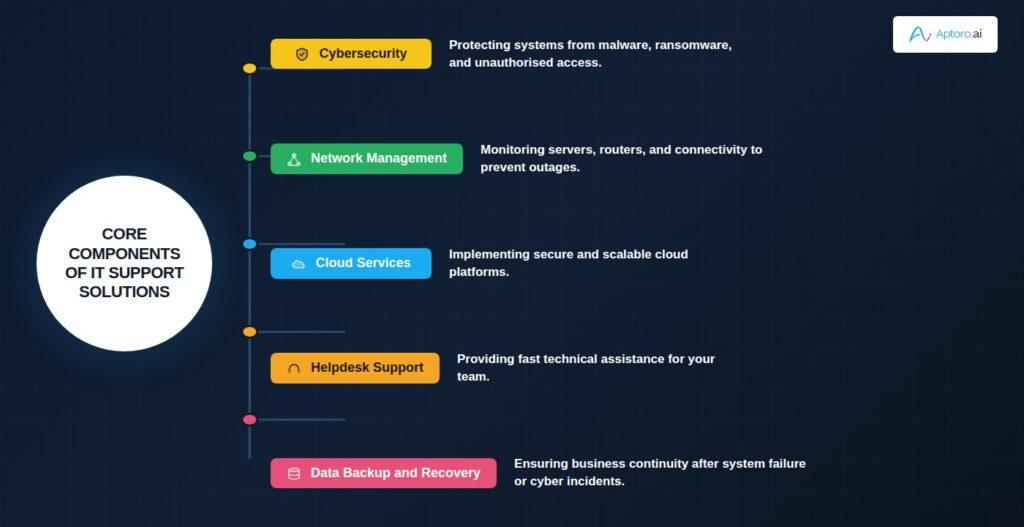
Core Components of IT Support Solutions
The diagram below shows how the five core components of a managed IT service work together to create a complete support structure for your business.
Signs Your Business Has Outgrown Its Current IT Setup
Not sure if managed IT support is right for you yet? Here are the warning signs that your current approach is costing you more than you think:
- Your team regularly loses time to slow systems, dropped connections, or software issues
- You have had at least one IT emergency in the past 12 months that caused real disruption
- You are not confident your data is being backed up properly, or at all
- Nobody in your business really owns cybersecurity
- You are paying for IT help reactively and never know what the bill will be
- You are planning to grow your team or move to hybrid working
If two or more of those apply, the cost of doing nothing is almost certainly higher than the cost of getting proper support in place.
How to Choose the Right Managed IT Support Provider
The UK market is crowded and most providers make very similar claims. Here is what to actually look for:
UK-based helpdesk with defined response times
Your provider should commit to specific response times in writing, ideally within 1 hour for critical issues. Offshore call centres reading from scripts are not IT support.
Cybersecurity included as standard, not as an add-on
In 2026, any managed IT package that treats cybersecurity as optional is not fit for purpose. EDR, email filtering, and MFA should be non-negotiable.
Transparent, all-inclusive pricing
Ask specifically: what is NOT included in the monthly fee? Project work, on-site visits, out-of-hours support, and additional devices are common extras that inflate the real cost.
Proactive approach, not just reactive
Ask how they monitor your systems, how often they patch, and whether they will flag potential issues before you notice them. A good provider prevents problems; a bad one just fixes them.
Long-term partnership mindset
Look for quarterly business reviews, a named account manager, and a genuine interest in your growth plans. Your IT provider should understand your business, not just your hardware.
Avoid long lock-in contracts
Quality providers are confident enough in their service to offer rolling monthly or 12-month terms. Be cautious of anyone pushing 36-month lock-ins without significant discounts.
The Business Case: What Managed IT Support Actually Delivers
Beyond keeping systems running, a good managed IT partner actively contributes to business performance:
- Reduced downtime: proactive monitoring prevents the majority of outages before they happen
- Predictable costs: fixed monthly fees replace unpredictable emergency repair bills
- Stronger security: enterprise-grade protection at SME-friendly pricing
- Freed-up focus: your team spends time on your business, not on IT problems
- Scalability: add users, sites, and services without infrastructure headaches
- Digital transformation support: expert guidance on cloud migration, automation, and new tools
Over time, the compounding effect of fewer incidents, lower repair costs, and a more productive team delivers a measurable return on the investment.
Get IT Support That Works as Hard as You Do
At Aptoro, we provide managed IT support for UK businesses that want technology to be reliable, secure, and genuinely useful, not a source of daily frustration. From proactive monitoring and cybersecurity to cloud management and strategic planning, we tailor our service around what your business actually needs.
If you are ready to stop firefighting and start growing, we would love to talk.
Frequently Asked Questions
What is the difference between managed IT support and break-fix IT support?
Break-fix IT support is reactive, you pay for help only when something goes wrong, typically at hourly rates of £75–£150. Managed IT support is proactive, your provider monitors and maintains your systems for a fixed monthly fee, preventing most issues before they cause disruption. For most small businesses, managed support works out cheaper over a year and far less stressful.
What should be included in a managed IT support package?
A quality package should include: helpdesk support with defined response times, proactive system monitoring, cybersecurity (EDR, email security, MFA), cloud services management, data backup and disaster recovery, network management, and regular strategic reviews. Be wary of providers who charge separately for cybersecurity or on-site visits.
Is managed IT support worth it for a small business?
Yes, for most small businesses. The fixed monthly cost is typically far lower than the combined cost of reactive emergency repairs, lost productivity from downtime, and the risk exposure from inadequate cybersecurity. With 43% of UK businesses experiencing a cyber breach in 2025/2026, the cost of not having proper support in place is increasingly real.
How does managed IT support help with cybersecurity?
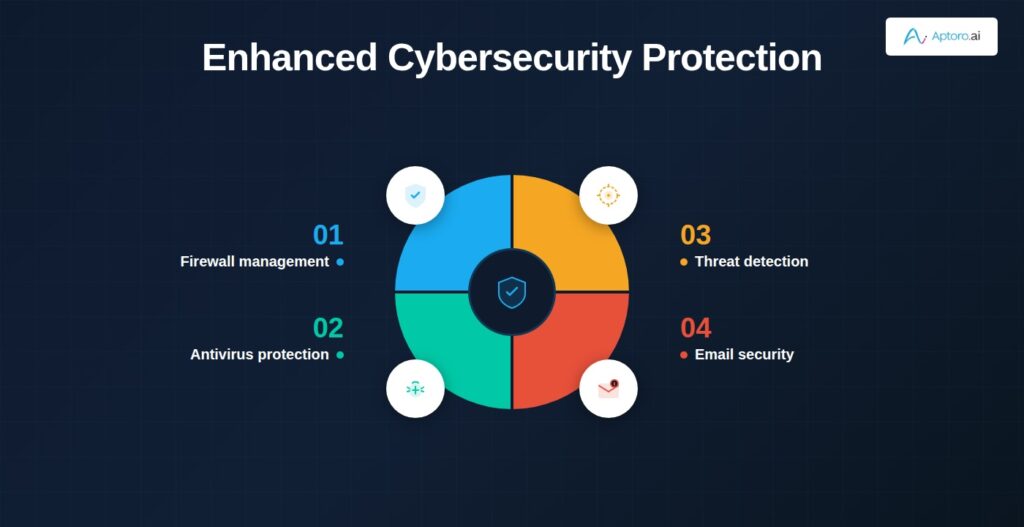
Managed IT support provides multi-layered cybersecurity protection including firewall management, endpoint detection and response (EDR), email filtering to block phishing attacks, multi-factor authentication, regular security patching, and continuous monitoring. Phishing was responsible for 85% of breaches in the 2025/2026 government survey, professional email security alone significantly reduces your exposure.
How quickly can my business get set up with managed IT support?
Most providers can onboard a new client within two to four weeks, depending on the size and complexity of your existing setup. At Aptoro, we begin with a thorough assessment of your current infrastructure so we can tailor the right support plan, you will never pay for services you do not need.
Can managed IT support work for remote or hybrid teams?
Yes. Modern managed IT support is built for distributed teams. Remote monitoring, cloud management, secure remote access, and helpdesk support all work regardless of where your team is located.
What should I look for when comparing IT support providers?
Look for: a UK-based helpdesk with defined response times, cybersecurity included as standard, transparent all-inclusive pricing, proactive monitoring capabilities, a named account manager, and flexible contract terms. Avoid providers who lead with low headline prices and then add essential services as extras.
