






Aptoro Data Driven Advertising: How to Turn Ad Clicks into Paying Customers
Most UK businesses running digital ads are wasting a significant portion of their budget. Not because they have the wrong product or the wrong platform, but because they are flying blind.
They set a campaign live, check the likes and impressions, and call it a success. Meanwhile, the metrics that actually matter, cost per lead, conversion rate, return on ad spend, tell a very
different story.
Data-driven advertising fixes this. Instead of guessing what might work, you track what does work, cut what does not, and compound the results over time. This guide explains how, and why UK businesses that embrace this approach are consistently outperforming those that do not.
Why Most UK Ad Budgets Are Being Wasted
The numbers are stark. According to research from LOCALiQ’s 2026 UK Digital Marketing Report, only 23% of UK marketing professionals rate their overall marketing performance as satisfactory. That means the vast majority of businesses are spending money on campaigns they know are underperforming, but do not know how to fix.
The core problem is almost always the same: a lack of proper tracking and testing. Without accurate data, you cannot know which ads are driving revenue, which audiences are converting, which platforms are delivering value, or which creative approach is resonating.
You can’t improve what you don’t measure. And in digital advertising, measuring correctly is not optional, it is the entire foundation of a profitable campaign.
65% of UK SMEs use paid search advertising. Yet a significant proportion report dissatisfaction with results, largely because campaigns are not built on a data-first foundation.
What Data-Driven Advertising Actually Means
Data-driven advertising is not about having a complex dashboard or running expensive software. It is about making every decision, from audience targeting to creative to budget allocation, based on real evidence rather than assumptions.
In practice, it means:
Tracking the full customer journey
From the moment someone sees your ad to the moment they become a customer, every step can be measured. Where are people dropping off? What pages are they visiting? How long are they taking to convert? Each of these data points tells you something actionable.
Testing systematically
Running A/B tests on ad creative, headlines, audiences, and landing pages is how you find out what actually works, not what you think will work. Video ads, for example, currently generate 48% higher engagement than static image ads on paid social platforms. But that average masks significant variation by industry, audience, and format. Testing tells you what the number is for your specific business.
Allocating budget based on performance
Once you know which audiences, platforms, and creatives are converting, you shift budget toward them and away from what is not performing. This sounds obvious, but the majority of campaigns never do it, they set a budget and leave it unchanged for months.
Retargeting intelligently
Most people who see your ad will not convert on the first visit. Retargeting, showing follow-up ads to people who have already engaged with your brand, is consistently one of the highest-return tactics in digital advertising. Without tracking, retargeting is impossible.
The Platforms: Meta vs Google, and When to Use Each
The two dominant platforms for UK digital advertising are Meta (Facebook and Instagram) and Google Ads. They work very differently, and understanding which is right for your objective is itself a data-driven decision.
Meta Ads (Facebook and Instagram)
Meta is the platform of choice for demand generation, reaching people who are not yet actively searching for what you offer, but who match the profile of someone who would be interested. With 54.8 million social media user identities in the UK and Facebook accounting for nearly 70% of UK social media web traffic, the reach is unmatched.
Meta’s average cost per click for lead generation campaigns sits around £1.50 to £2.50 in the UK, significantly lower than search advertising. The trade-off is intent: you are interrupting someone’s feed rather than meeting them at the moment they are actively searching. Strong creative and smart audience targeting are therefore essential.
36% of UK businesses report their best return on ad spend from Meta and Facebook, the highest of any single platform.
Google Ads
Google Ads captures demand that already exists. When someone searches for your product or service, your ad appears at the top of the results. The intent is higher, which is why average conversion rates on Google Search (around 7%) are typically higher than on paid social.
The trade-off is cost, Google CPCs are higher, and competition is intense in most UK industries. For most businesses, the most effective approach combines both: Google to capture high-intent searches, Meta to build awareness and retarget.
65% of UK SMEs currently use paid search advertising. For those running both search and paid social with proper tracking in place, the combined effect consistently outperforms either channel in isolation.
The Sales Funnel: Understanding the Path to Purchase
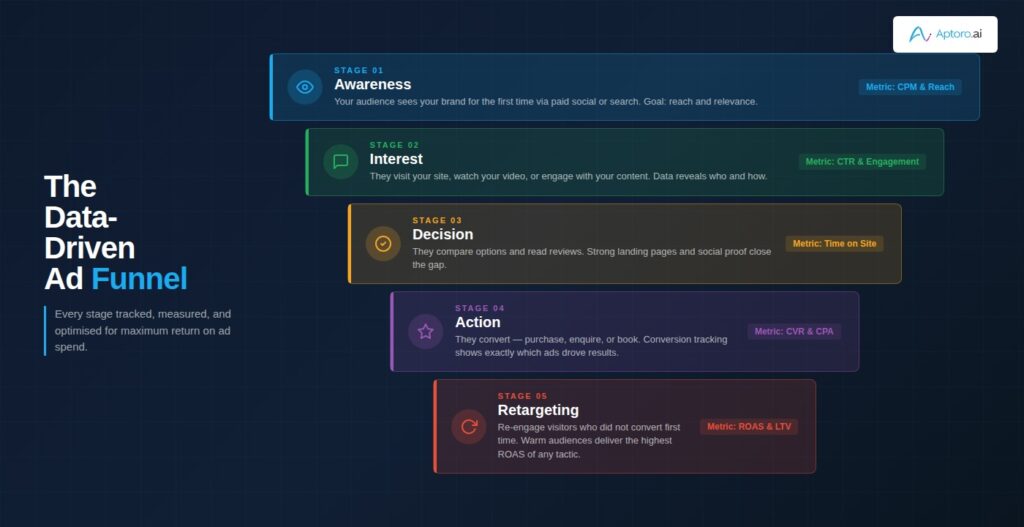
Every customer takes a journey before making a purchase. Understanding that journey, and using data to support people at each stage, is what separates profitable ad campaigns from wasted spend.
- Awareness: The customer sees your brand for the first time. The goal here is reach and relevance, not immediate conversion.
- Interest: They visit your website, watch your video, or engage with your content. Data tells you who is engaging and how.
- Decision: They compare options, read reviews, and consider their choices. This is where strong landing pages and social proof do the heavy lifting.
- Action: They convert — make a purchase, book a call, or submit an enquiry. Conversion tracking tells you exactly which ads and audiences drove this.
- Retention: They become a repeat customer. Retargeting and email follow-up keep your brand front of mind and drive lifetime value.
Data connects these stages. If people are clicking your ads but not converting on your website, the problem is the landing page, not the ad. If they are converting but not returning, the problem is the post-purchase experience. Each stage produces data that tells you precisely where to focus your attention.
What Good Campaign Tracking Looks Like
Effective tracking goes beyond counting clicks. The metrics that actually matter for a data-driven campaign are:
- Cost per lead (CPL): How much does it cost to generate one enquiry or sign-up? This is the first number to establish and then work to reduce.
- Conversion rate (CVR): What percentage of people who click your ad take the desired action? Industry averages for Google Search sit around 7%, but this varies significantly by sector.
- Return on ad spend (ROAS): For every pound spent on advertising, how many pounds of revenue are generated? A ROAS of 3x or above is a common baseline target for ecommerce.
- Cost per acquisition (CPA): How much does it cost to acquire one paying customer? This is the number that determines whether a campaign is profitable.
- Click-through rate (CTR): What percentage of people who see your ad click it? The UK average CTR for paid search is 4.3%. A significantly lower rate suggests your ad copy or targeting needs work.
These metrics only become useful when tracked consistently over time. A single week of data tells you very little. A month of data starts to show patterns. Three months of data gives you enough to make confident, evidence-based decisions about where to invest.
The Role of Creative in a Data-Driven Strategy
Data tells you what is working, but it is creativity that makes things work in the first place. The most sophisticated targeting in the world will not save a weak ad.
In 2026, the creative formats generating the strongest results on paid social are short-form video (particularly on TikTok and Instagram Reels), user-generated content that feels native to the platform, carousel ads for showcasing multiple products or benefits, and direct-response copy that leads with a specific problem and a clear solution.
The key is to let data guide creative decisions rather than relying on instinct alone. Test two versions of an ad, different headlines, different visuals, different calls to action, and let the performance data tell you which to scale. This removes opinion from the equation and replaces it with evidence.
AI-optimised social campaigns are now up to 40% more efficient than 2024 benchmarks on platforms like Meta and Google, largely because machine learning can optimise creative delivery at a speed and scale no human team can match. But the creative still has to be good in the first place.
Building a Data-Driven Ad Strategy: A Practical Framework
For UK businesses looking to move from guesswork to a genuine data-driven approach, the process looks like this:
- Set up tracking properly before spending a penny
Meta Pixel, Google Tag Manager, and conversion tracking should be in place and verified before any campaign goes live. If you cannot track conversions, you cannot optimise. This step is non-negotiable. - Define your metrics before you launch
What does success look like? Agree on your target CPL, CPA, or ROAS before the campaign starts. This gives you a benchmark to measure against and prevents the common trap of celebrating vanity metrics while ignoring the numbers that matter. - Start with a testing phase
The first four to six weeks of any new campaign should be treated as a testing phase. Run multiple ad variations across different audiences and let the data show you what is working. Resist the urge to make changes too quickly, statistical significance takes time. - Optimise based on evidence
Once you have meaningful data, make decisions based on it. Shift budget toward the audiences and creatives that are performing. Pause what is not. Continuously refine your targeting based on who is actually converting, not who you think will convert. - Build your retargeting audiences
As your campaigns run, you build audiences of people who have engaged with your brand but not yet converted. These warm audiences are significantly more cost-effective to convert than cold audiences. A well-structured retargeting strategy is often the highest-return element of a paid media plan.
How Aptoro Approaches Data-Driven Advertising
At Aptoro, data is the starting point for every campaign we build. Before we write a single line of ad copy or design a single creative, we work to understand your audience, your conversion goals, and the metrics that define success for your specific business.
From there, we build campaigns designed to generate evidence, not just impressions. We test, track, and optimise continuously, sharing regular performance reports so you can see exactly where your budget is going and what it is returning.
Whether you are running Meta ads, Google Ads, or a combination of both, our approach is the same: every decision is driven by data, and every pound spent has a clear purpose.
Frequently Asked Questions
What is data-driven advertising and how does it differ from traditional advertising?
Data-driven advertising uses real performance data, click-through rates, conversion rates, cost per lead, return on ad spend, to make every campaign decision. Traditional advertising relies on estimates and assumptions. The difference in outcome is significant: data-driven campaigns can be continuously improved based on evidence, while traditional approaches rely on
guesswork and gut feel.
Which is better for UK businesses, Meta Ads or Google Ads?
It depends on your objective. Google Ads is best for capturing demand that already exists, people actively searching for your product or service. Meta (Facebook and Instagram) is better for generating demand, reaching people who match your ideal customer profile before they are actively searching. The most effective strategies for most UK businesses combine both, using
Google for high-intent traffic and Meta for awareness and retargeting.
How much should a UK small business spend on digital advertising?
There is no universal answer, but as a practical guide, most UK small businesses need at least £30 to £80 per day on Google Ads to collect enough data for meaningful optimisation. For Meta, you can start smaller, £500 to £1,000 per month gives you enough budget to test audiences and creative variations. The key is committing to a testing phase before judging results.
How long does it take to see results from data-driven advertising?
The first four to six weeks should be treated as a testing phase,the goal is to collect data, not to judge the campaign. Meaningful patterns typically emerge after six to eight weeks. By month three, you should have enough evidence to make confident decisions about where to allocate budget and what to scale.
What metrics should I be tracking for my ad campaigns?
The most important metrics are cost per lead (CPL), conversion rate (CVR), return on ad spend (ROAS), cost per acquisition (CPA), and click-through rate (CTR). Vanity metrics like impressions and likes are less important, focus on the numbers that connect directly to revenue.
What is retargeting and why does it matter?
Retargeting shows ads to people who have already interacted with your brand, visited your website, watched your video, or clicked a previous ad, but have not yet converted. These audiences are significantly more likely to convert than cold audiences because they already have some familiarity with your brand. A well-structured retargeting strategy is often the highest-return element of a paid media plan.
How does Aptoro approach digital advertising campaigns?
Aptoro builds every campaign on a data-first foundation, setting up proper tracking, defining success metrics upfront, running structured testing phases, and optimising continuously based on performance data. We provide regular reporting so clients can see exactly where their budget is going and what it is returning. Get in touch at aptoro.ai/contact to discuss your specific goals.
