





AI Automation for Small Businesses UK: Where to Start and Want to Automate
There is a growing divide running through UK business. On one side are the companies using AI automation to handle repetitive tasks, process data, manage compliance, and serve customers around the clock. On the other are the companies watching from the sidelines, unsure where to start or whether it applies to them.
The numbers tell the story clearly. According to DSIT’s January 2026 research, only 16% of UK businesses currently use AI, compared to 88% globally. That gap represents both a warning and an opportunity. The businesses that close it now will compound the advantage every year. Those that wait will find it increasingly expensive to catch up.
This guide cuts through the hype and explains what AI automation actually means for a UK small business in 2026, what it includes, where to start, and what the businesses already doing it are achieving.
What is AI Automation and What Is It Not?
AI automation is the use of artificial intelligence to perform tasks that would otherwise require human time and attention. It is not about replacing your entire team with robots. It is about removing the manual, repetitive, low-value work that takes time away from the things that actually grow your business.
In practice, AI automation for a UK small business might look like: a system that qualifies and responds to new leads within seconds, 24 hours a day; software that processes invoices and flags anomalies without anyone manually reviewing them; a chatbot that handles your most common customer queries so your team only deals with the complex ones; or automated reporting that pulls data from multiple sources and delivers a summary to your inbox every Monday morning.
None of these require an enterprise budget or an in-house data science team. They require the right tools, correctly configured, and integrated into how your business already operates. The key distinction is between automation that saves time and automation that creates value. The best AI implementations do both, removing manual work while simultaneously improving the quality and speed of the output.
Why Now? The UK AI Adoption Gap
The 16% UK adoption figure from DSIT is striking, but the direction of travel matters as much as the current number. That figure has roughly doubled in 18 months, and the British Chambers of Commerce reports that 35% of UK SMEs are now actively using AI in at least one business function.
What is driving the acceleration? Three things. First, the tools have become dramatically more accessible, many AI automation platforms now require no coding knowledge and can be configured by a non-technical team member. Second, the cost has dropped significantly; capabilities that required enterprise budgets in 2022 are now available to small businesses for a few hundred pounds a month. Third, the evidence base has grown, there are now enough real-world case studies from UK businesses to make the business case concrete rather than theoretical.
The businesses seeing the strongest results are not the ones with the biggest AI budgets. They are the ones that identified a specific, high-volume problem and automated it well.
Where AI Automation Delivers the Most Value for UK Businesses
Not every business process is equally suited to automation. The highest-return opportunities share three characteristics: they are high volume, they are repetitive, and they currently create a bottleneck or cost a meaningful amount of time.
Customer Service and Lead Response
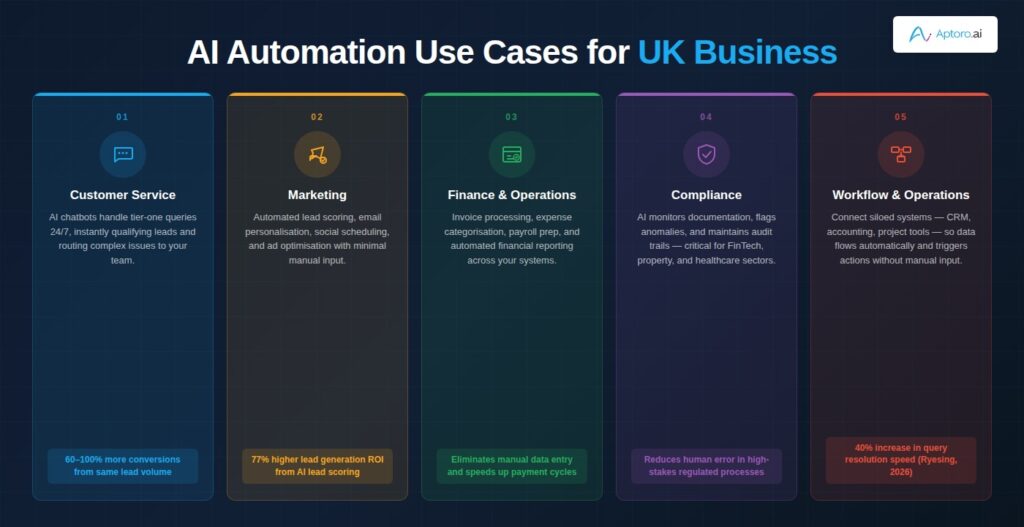
For most UK small businesses, speed of response is a significant competitive differentiator, and a significant source of lost revenue. Research shows that service businesses miss between 27% and 62% of inbound enquiries while staff are occupied. AI-powered response systems can acknowledge, qualify, and route enquiries in seconds rather than hours, 24 hours a day,
seven days a week.
Businesses implementing automated lead response and follow-up sequences report 60 to 100% more conversions from the same lead volume, simply by ensuring no enquiry goes unanswered. This is one of the most immediate and measurable applications of AI automation for UK SMEs.
Marketing Automation
Marketing represents the most mature category of AI automation for small businesses. Lead scoring, automatically ranking prospects by their likelihood to purchase, delivers 77% higher lead generation ROI according to HubSpot’s research. Email personalisation, social media scheduling, ad optimisation, and customer segmentation can all now be handled with minimal
manual intervention.
The more sophisticated application is using AI to analyse customer behaviour patterns, predicting which customers are likely to churn, identifying upsell opportunities, and personalising website content in real time based on who is visiting.
Finance and Operations
Invoice processing, expense categorisation, payroll preparation, and financial reporting are all strong candidates for automation. These are high-volume, rules-based tasks where errors are costly and the time investment is significant. AI tools can process documents, flag anomalies, and generate reports at a fraction of the time and cost of manual processing.
For businesses operating in regulated sectors, financial services, healthcare, property, education, AI is also increasingly being used for compliance monitoring, documentation checking, and audit trail management. Aptoro’s work on automated mortgage compliance is a practical example of how AI can handle a high-stakes, high-volume compliance process that previously required significant manual oversight.
Education and Training Management
For businesses in education, professional services, or any sector that manages structured learning or onboarding, AI automation can handle scheduling, progress tracking, assessment, and communication at scale. Aptoro’s education management automation system demonstrates how these workflows, which typically require significant administrative overhead, can be handled largely automatically, freeing staff to focus on the actual teaching or delivery.
Workflow and Process Integration
Beyond individual function automation, AI can connect systems that currently require manual data transfer between them. If your CRM, accounting software, project management tool, and communication platform all operate in silos, you are almost certainly duplicating data entry and losing information in the gaps. Workflow automation tools can connect these systems so data flows automatically, triggers actions, and keeps everything in sync without manual intervention.
Real Applications: What UK Businesses Are Actually Automating
The most useful way to understand AI automation is through what businesses are actually doing with it, rather than what is theoretically possible. Here are the use cases generating consistent ROI for UK SMEs in 2026:
- Automated enquiry response and lead qualification – capturing and responding to inbound interest within seconds
- AI-powered compliance checking – particularly in financial services, property, and regulated sectors
- Automated appointment booking and calendar management – eliminating back-and-forth scheduling
- Invoice and document processing – reducing manual data entry and speeding up payment cycles
- Customer support chatbots – handling tier-one queries so human agents focus on complex issues
- Automated reporting and dashboards – pulling data from multiple sources into a single weekly or daily summary
- Email sequence automation – nurturing leads through a buying journey without manual follow-up
- Social media scheduling and content distribution – maintaining consistent presence without daily manual posting
The common thread is not the sophistication of the technology, it is the clarity of the problem being solved. The businesses achieving the best results start with a specific, measurable pain point and automate it well, rather than trying to implement AI across every function simultaneously.
How to Start: A Practical Framework for UK Businesses
Step 1. Audit your time before choosing your tools
Before evaluating any AI platform, spend a week tracking where your team’s time actually goes. The processes that consistently consume disproportionate time, especially if they involve repetitive steps, manual data entry, or predictable decision-making, are your best automation candidates.
Step 2. Start with one high-impact process
The businesses that fail at AI automation typically try to do too much at once. Pick one process, ideally something with high volume, clear rules, and a measurable outcome, and automate it properly. Learn from that implementation before expanding.
Step 3. Choose integration over standalone tools
AI tools that connect to your existing systems (CRM, email, accounting software) deliver more value than standalone platforms that create yet another silo. Before committing to any tool, verify it integrates with what you already use.
Step 4. Measure the right things
Define your success metric before you start, time saved per week, leads responded to within five minutes, invoices processed per day. Without a baseline and a target, you cannot evaluate whether the automation is working or identify where to improve it.
Step 5. Plan for human oversight
UK GDPR Article 22 restricts fully automated decisions on significant matters like credit, employment, or service access, these require human oversight. Beyond the legal requirement, most AI automation works best as augmentation rather than replacement. Build review points into your automated processes so a human can catch errors and refine the system over time.
What AI Automation Costs for a UK Small Business
Cost is the question most businesses ask first, and the honest answer is: far less than most expect. The comparison to traditional approaches is where the real value becomes clear.
A traditional approach to the same volume of work, additional staff, manual processes, reactive problem-solving, typically costs £30,000 to £48,000 per year in salary alone for a mid-sized service business. A well-configured AI automation system handling the same workload costs £7,800 to £9,000 per year in platform and maintenance costs, with performance that is faster, more consistent, and available around the clock.
For most UK small businesses, the entry point is still lower. Many AI automation tools start at £50 to £300 per month for small business tiers. The investment that delivers ROI is not the tool cost, it is the time spent configuring it correctly for your specific business processes. That is where working with an experienced implementation partner makes the difference between a tool that saves two hours a week and one that transforms an entire workflow.
How Aptoro Approaches AI Automation
At Aptoro, AI automation is one of our core service areas, and we have delivered it across a range of sectors and business types, from automated mortgage compliance systems in financial services to education management platforms and on-demand service applications.
Our approach starts with understanding your business processes before recommending any technology. We identify where automation will create the most value, design systems that integrate with your existing tools, and build in the monitoring and oversight needed to ensure the automation keeps working as your business evolves.
Whether you need a custom-built automation system or help implementing and configuring existing platforms, we can help you move from manual processes to intelligent automation, without the complexity or the enterprise price tag.
Frequently Asked Questions
What is AI automation and how does it work for small businesses?
AI automation uses artificial intelligence to perform repetitive, rules-based tasks that would otherwise require manual time and attention, things like responding to enquiries, processing documents, scheduling, and generating reports. For small businesses, it typically works by connecting AI tools to your existing systems so that data flows automatically, actions are triggered without manual intervention, and your team’s time is freed for higher-value work.
Where should a UK small business start with AI automation?
Start by identifying your highest-volume, most repetitive processes, the tasks that consistently consume disproportionate time and follow predictable rules. Common starting points for UK SMEs include lead response and qualification, customer support, invoice processing, and automated reporting. Pick one, automate it well, measure the result, and expand from there.
Is AI automation legal in the UK? What are the regulations?
AI automation is legal in the UK and actively encouraged as part of the government’s pro-innovation approach. The key regulatory consideration is UK GDPR Article 22, which restricts fully automated decisions on significant matters, employment, credit, or service access, requiring human oversight for these decisions. For most small business automation use cases (marketing, scheduling, document processing, customer service), there are no specific restrictions beyond standard GDPR data handling requirements.
What industries benefit most from AI automation in the UK?
AI automation delivers strong results across most industries, but the sectors seeing the highest ROI in the UK right now are financial services (compliance, document processing, lead management), professional services (scheduling, reporting, client communication), education (management systems, student tracking, assessment), healthcare and pharmacy (appointment
booking, prescription management), and ecommerce (order processing, customer service, personalisation).
How does Aptoro help businesses implement AI automation?
Aptoro designs and builds custom AI automation systems tailored to your specific business processes, as well as helping businesses configure and integrate existing AI platforms. Our work spans automated compliance systems for financial services, education management platforms, on-demand service applications, and workflow automation across sectors. We start by understanding your current processes and identifying where automation will create the most measurable value.
