







Aptoro eCommerce
The UK is Europe’s largest ecommerce market. Online retail now accounts for roughly 30% of all UK retail transactions, and the market is forecast to grow from £127 billion in 2024 to well over £200 billion by the end of the decade. That is an extraordinary amount of opportunity, but also an extraordinary amount of competition.
The brands winning in this environment are not simply the ones selling the best products. They are the ones making smarter decisions about technology, customer experience, and digital strategy. They understand where attention is going, and they show up there first.
This guide breaks down the ecommerce trends that matter most for UK businesses in 2026, and what you should actually be doing about each one.
1. AI Personalisation Is Moving from Nice-to-Have to Non-Negotiable
Artificial intelligence has quietly become the engine underneath the best-performing ecommerce stores. Not in a futuristic, theoretical way, in a very practical, revenue-driving way.
AI is now being used to personalise product recommendations based on browsing behaviour, generate tailored email campaigns for different customer segments, power chatbots that handle customer queries around the clock, set dynamic pricing based on demand and competitor activity, and predict which customers are likely to churn before they do.
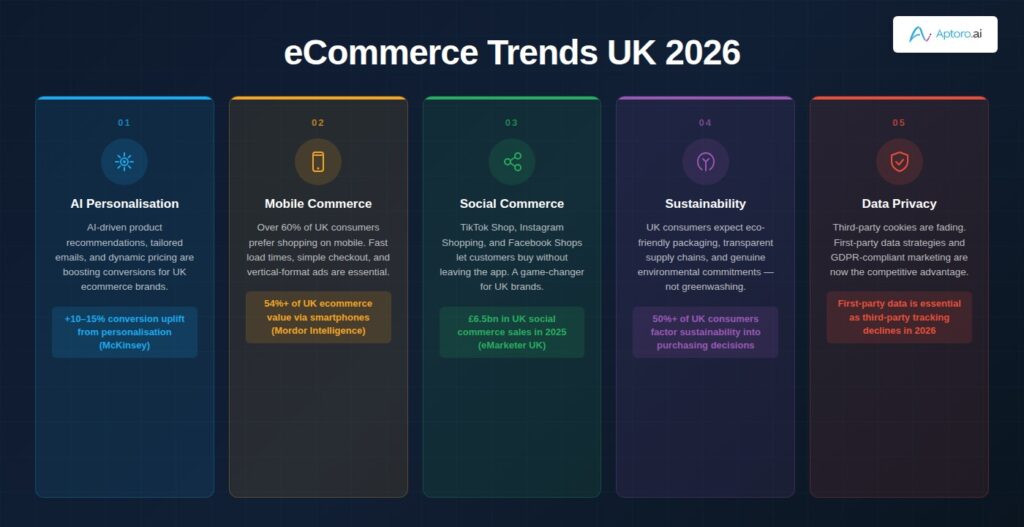
The results are measurable. Research from McKinsey shows that ecommerce brands that personalise their customer journeys see conversion rates increase by 10 to 15%. For a store turning over £500,000 a year, that is a significant number.
The shift happening in 2026 is from basic product recommendations to what is being called agentic commerce, where AI assistants browse, compare, and even purchase on behalf of customers. UK brands need structured, high-quality product data to show up in these AI-driven results.
What this means for your business: invest in tools that capture first-party customer data, segment your audience properly, and automate personalised communications at scale. If you are still sending the same email to your entire list, you are leaving money on the table.
2. Mobile Commerce Is Now the Default, Not the Exception
Over 60% of UK consumers now prefer shopping on mobile devices, according to eMarketer. Smartphones already account for more than half of all UK ecommerce transactions by value, and that share is still growing.
This is not a trend to prepare for, it is the current reality. Yet a surprising number of UK ecommerce sites still deliver a frustratingly slow or clunky mobile experience. Pages that take more than three seconds to load lose the majority of their visitors. Checkout flows with too many steps see cart abandonment rates soar.
Mobile-first in 2026 means:
- Sub-two-second page load times on mobile networks
- A checkout process completable in two taps or fewer
- Vertical-format creative for ads on Instagram, TikTok, and YouTube
- Integrated payment options including Apple Pay, Google Pay, and BNPL
- Google’s mobile-first indexing applied to your SEO strategy
If your website was built more than three years ago and has not been significantly updated, a mobile performance audit should be your first priority. A slow mobile site does not just lose sales, it actively damages your search rankings.
3. Social Commerce Is Reshaping How People Discover and Buy
Social commerce, the ability to browse and buy products without leaving a social media platform, is no longer a novelty. In 2025, social commerce accounted for nearly £6.5 billion of UK retail sales, and growth is accelerating in 2026 driven by TikTok Shop, Instagram Shopping, and Facebook Shops.
The opportunity this creates for smaller UK brands is significant. You no longer need a huge budget or a large marketing team to reach a targeted, engaged audience. What you need is strong creativity, a clear value proposition, and a checkout experience that does not create friction.
The platforms are actively making it easier to sell in-app. Ads can target by interest, age, location, purchase behaviour, and lookalike audiences built from your existing customers. For brands with good creative and the right targeting strategy, social commerce can generate a better return on ad spend than almost any other channel.
The brands seeing the best results are not just running ads, they are creating content that feels native to each platform and using data to find and retarget the right audiences at the right moment.
4. First-Party Data Is the New Competitive Advantage
Third-party cookies are being phased out across major browsers, and UK data protection requirements under GDPR continue to tighten. For ecommerce brands that have relied on third-party tracking to power their advertising and retargeting, this is a significant challenge.
The businesses that will thrive are those building direct relationships with their customers and collecting first-party data, email addresses, purchase history, preferences, and behaviour, with clear consent.
This means:
- Email and SMS lists built on genuine opt-in
- Loyalty programmes that incentivise data sharing
- Post-purchase surveys and preference centres
- On-site behaviour tracking via first-party analytics tools
First-party data does not just protect you from the decline of third-party cookies, it gives you a cleaner, more accurate picture of who your customers actually are and what they respond to. Brands that invest in building these foundations now will have a significant advantage as the data landscape continues to shift.
5. Sustainability Is Now a Commercial Expectation
Consumer attitudes towards sustainability have hardened. This is no longer a differentiator for premium brands, it is increasingly a baseline expectation across all segments.
UK shoppers want to support brands that use sustainable packaging, are transparent about their supply chain, offset or reduce their carbon footprint, and give back to communities. Brands that can demonstrate genuine commitment, not just green-washed marketing copy, are building stronger customer loyalty as a result.
The commercial case is clear. In the UK, over 50% of consumers factor sustainability into their purchasing decisions. And with UK retail facing margin pressure from rising costs, the loyalty and repeat purchase rates that come with strong brand values are more valuable than ever.
What this means practically: make your sustainability commitments specific and measurable. Vague claims about being eco-friendly will not cut through. Customers and regulators are increasingly scrutinising sustainability claims, and the ASA has taken action against misleading green marketing in the UK. Show your work.
6. Speed and Convenience Remain the Baseline
In ecommerce, friction kills conversions. Every unnecessary step in a checkout flow, every slow-loading page, every confusing returns process represents lost revenue.
Customer expectations around speed and convenience continue to rise in 2026:
- Same-day and next-day delivery is increasingly expected, not a premium
- Real-time order tracking is standard
- Instant customer support via chat or AI assistant
- Seamless, no-quibble returns and exchanges
Meeting these expectations requires investment in the right infrastructure, fast, reliable hosting, efficient fulfilment partnerships, and automated customer service tools. The good news is that improvements in site speed and checkout flow often produce immediate, measurable uplifts in conversion rate. This is one of the highest-return areas of investment for most ecommerce
businesses.
7. Data Privacy and GDPR Compliance Build Customer Trust
As data becomes increasingly central to ecommerce growth, customer concern about privacy is growing alongside it. UK consumers want to know their data is being handled responsibly, and with GDPR enforcement activity increasing, businesses cannot afford to treat compliance as optional.
The brands that will win long-term are those that treat data privacy not as a legal box to tick but as a genuine commitment to their customers. Being transparent about what data you collect, why you collect it, and how it is used builds the kind of trust that translates into repeat purchases and word-of-mouth referrals.
Practically, this means consent-based marketing, clear privacy policies written in plain English, and advertising methods that respect user preferences. It also means working with digital partners who understand GDPR and follow compliant practices, because non-compliance can result in significant fines and reputational damage.
8. The Technologies to Watch Beyond 2026
Looking further ahead, several technologies are moving from experimental to mainstream:
Voice and AI Shopping Assistants
Voice search is growing as smart speakers and AI assistants become more embedded in daily life. Optimising product listings and content for conversational, question-based queries will become increasingly important for discoverability.
Augmented Reality (AR) Shopping
AR allows customers to visualise products in their own space before buying, particularly valuable for furniture, homeware, beauty, and fashion. Retailers using AR tools are seeing measurable reductions in return rates. This technology is moving out of the experimental phase and into mainstream retail in 2026.
Live Shopping
Live shopping events, where products are demonstrated and sold in real time via video, are growing rapidly in the UK, following the model already established in Asia. For brands with engaging presenters and the right products, live shopping creates urgency and community simultaneously.
Buy Now Pay Later (BNPL)
BNPL continues to grow as a payment option, particularly among younger shoppers. Under new FCA regulation, BNPL providers are now subject to greater oversight, which should increase consumer confidence. Integrating regulated BNPL options at checkout can meaningfully increase average order values.
What This Means for Your Business
The thread running through every trend in this guide is the same: customers expect more, competition is higher, and the gap between businesses that embrace digital strategy and those that do not is widening every year.
The good news is that most of these opportunities do not require enterprise-level budgets. They require the right strategy, the right tools, and a partner who understands the digital landscape.
At Aptoro, we work with growing UK brands across digital marketing, website development, SEO, and AI automation, helping them navigate exactly these challenges and turn them into competitive advantages. Whether you need a faster, higher-converting website, a smarter paid social strategy, or help building a data-driven marketing engine, we can help.
Frequently Asked Questions
What are the biggest ecommerce trends in the UK for 2026?
The most significant ecommerce trends for UK businesses in 2026 are AI-driven personalisation, mobile-first commerce, social commerce growth (particularly TikTok Shop and Instagram Shopping), first-party data strategies, sustainability expectations, and the rise of AR shopping experiences. Brands that act on these trends now will be ahead of competitors still catching up.
How important is mobile commerce for UK businesses in 2026?
Extremely important. Over 60% of UK consumers prefer shopping on mobile, and smartphones account for more than half of all ecommerce transactions by value. If your website is slow, hard to navigate, or difficult to checkout on mobile, you are losing a significant portion of potential sales. Mobile optimisation should be a top priority for any ecommerce business.
What is social commerce and how can UK brands use it?
Social commerce allows customers to discover and purchase products directly within social media platforms like Instagram, Facebook, and TikTok without leaving the app. UK brands can use it by setting up shoppable posts and in-app stores, running targeted paid social campaigns, and creating native content that drives purchase intent. In 2025, social commerce accounted for nearly £6.5 billion in UK retail sales.
Why is first-party data so important for ecommerce in 2026?
Third-party cookies are being phased out, reducing the effectiveness of traditional tracking and retargeting. First-party data, collected directly from your customers with their consent, gives you a reliable, accurate foundation for personalisation, email marketing, and audience targeting. Brands building strong first-party data strategies now will have a significant competitive advantage.
How can small UK ecommerce brands compete with larger retailers?
Small brands can compete by focusing on areas where agility is an advantage: niche personalisation, authentic brand storytelling, faster customer service, and building genuine community on social media. Smart use of paid social, email marketing, and SEO can deliver disproportionate returns for smaller budgets when executed well. The right digital agency partner can help level the playing field.
How does Aptoro help ecommerce businesses grow?
Aptoro works with growing UK ecommerce brands across digital marketing, website development, SEO optimisation, and AI automation. We help businesses build faster, higher-converting websites, create data-driven marketing strategies, and implement the technology tools needed to compete effectively in 2026 and beyond. Get in touch at aptoro.ai/contact to discuss your specific goals.
